

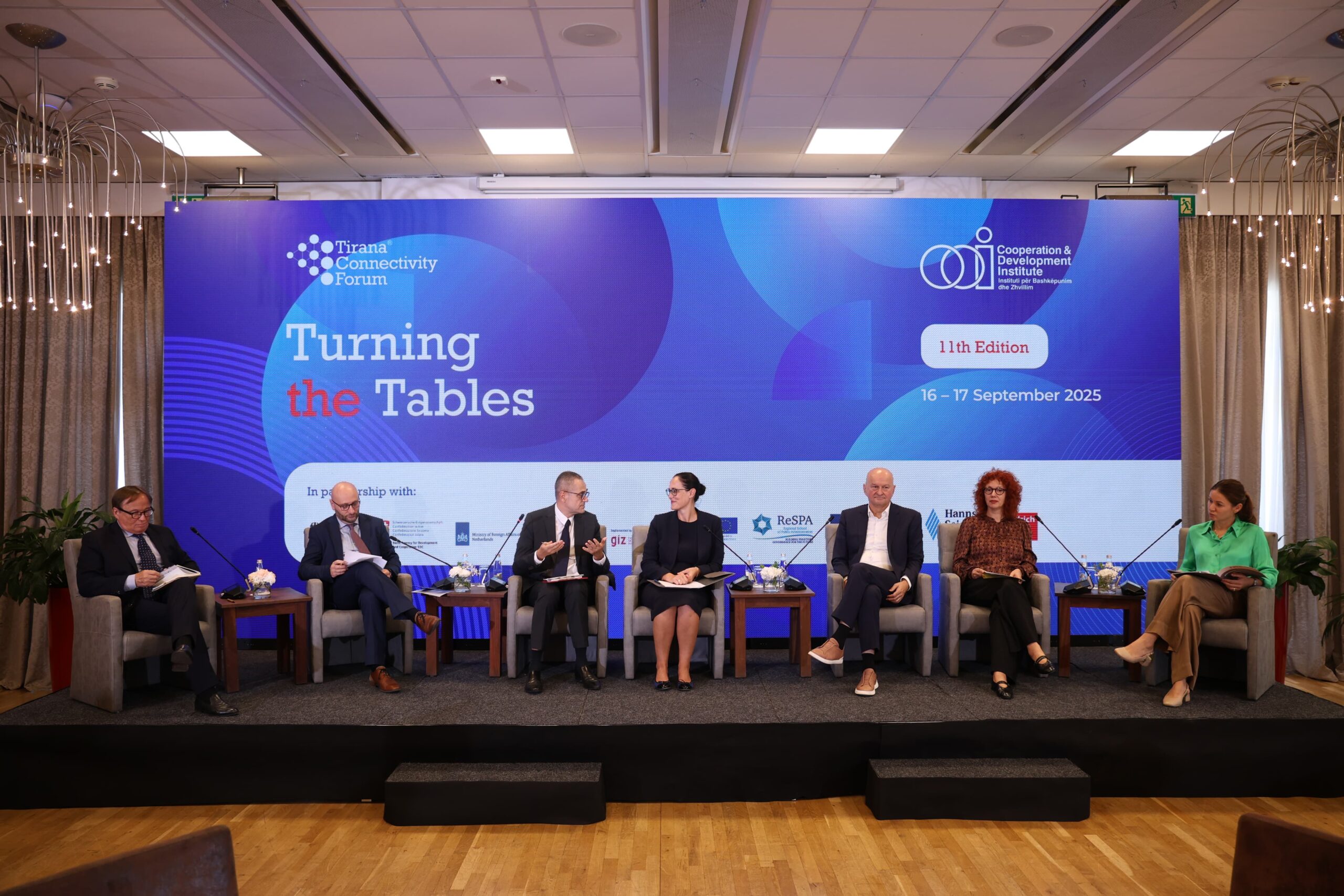
The second panel of TCF2025 explored how the South East Europe 6 (SEE6) contributes to Europe’s competitiveness. On top of Critical Raw Materials, near-shoring, agri-business or increased connectivity, aligning its reforms with EU priorities, boosting regional cooperation, and unlocking the potential of businesses and entrepreneurs multiplies region’s added value to Union’s economy.
The discussion highlighted a strong consensus on the region’s strategic value to the EU all by underscoring the urgent need for accelerated reforms, smarter cooperation, and a fundamental shift in the narrative presented to European investors.
Albania’s designated Minister of Economy and Innovation, Delina Ibrahimaj stressed that accession is not merely a bureaucratic process but rather a reform agenda that prepares businesses to benefit from the EU Single Market. She highlighted Albania’s push towards digital governance, improved infrastructure, and higher production standards as key steps to attract investment and integrate with European value chains.
From the European Commission, Giorgio Zecca underlined the importance of the “triangle of priorities”: alignment with the acquis, strengthening the rule of law, and mobilizing financial instruments. He noted that economic growth cannot advance without trust in legal certainty, while also pointing to ongoing initiatives such as SEPA, roaming, and green lanes as concrete steps bringing SEE6 closer to the EU’s single market.
Entrepreneur and academic Stjepan Orešković offered a critical perspective on Europe’s competitiveness, arguing that the region must focus on supporting entrepreneurs and companies with global growth potential rather than insisting on maintaining uncompetitive industries. He presented the “Future 500” initiative as a way to spotlight firms capable of becoming future European champions, while also noting that Albania and the whole SEE6 region has the energy and talent to surprise with new success stories.
Blerina Raca, from GIZ Albania provided a ground-level perspective, highlighting the critical need to better prepare and “shake up” Albanian businesses for the realities of the Single Market. She detailed existing yet underutilized EU programs available to Albanian companies now, such as Horizon Europe and the Single Market Programme, urging businesses to get informed and proactively seize these opportunities.
Representing the private sector, Marinela Jazoj from the Foreign Investors Association of Albania, called for more a inclusive and efficient implementation of reforms. An effective cooperation between government, institutions, and business is required, as well as closer ties with EU partners to ensure that opportunities from instruments such as the Growth Plan or the upcoming Cohesion and Competitiveness-related instruments translate into real benefits for local companies.
Jean-Christophe Bass from the Aspen Institute delivered a crucial external perspective, warning about the “information gap” and outdated stereotypes about the region. He argued for a proactive “Team Albania/Western Balkans” advocacy campaign for an evidence-based narrative that highlights SEE6 economies as contributors, not just beneficiaries, of Europe’s prosperity—showcasing success stories, opportunities and partnerships, and the region’s role in strengthening Union’s resilience at a time of global uncertainty.
In a video-message address, Deputy Minister of Economy and Innovation Olta Manjani, presented the upcoming EU–Western Balkans Investment Forum, that will take place in Tirana in mid October 2025. The Investment forum will focus on nearshoring, regional cooperation, and showcasing promising sectors such as ICT, renewable energy, agribusiness, and tourism, with the aim of translating multi-partner dialogue into concrete investment partnerships. She underlined Albania’s strategic advantages—its location, youthful workforce, and reform trajectory—while stressing that SEE6 should be viewed not as a periphery, but as a strategic extension of the EU Single Market.
The panel concluded that the list of opportunities for the Western Balkans is longer and much more relevant than the list of perceived risks. The region is poised to be a strategic extension of the EU single market, particularly through nearshoring. Due to its current position and government commitment, Albania can be EU’s innovation Pit where new technologies – and especially AI for Public Services – constitute an absolute competitive advantage.
However, unlocking this potential requires a dual track approach: internally, a relentless focus on implementing rule of law and business environment reforms is non-negotiable; while externally, a confident, evidence-based narrative accompanied by targeted support measures must be broadcast across the EU to change perceptions and attract strategic investment. The success of the Montenegro and Albania 2030 Membership target depends on this synergy—turning the tables from being perceived as beneficiaries to becoming indispensable partners in a more competitive Europe.


