

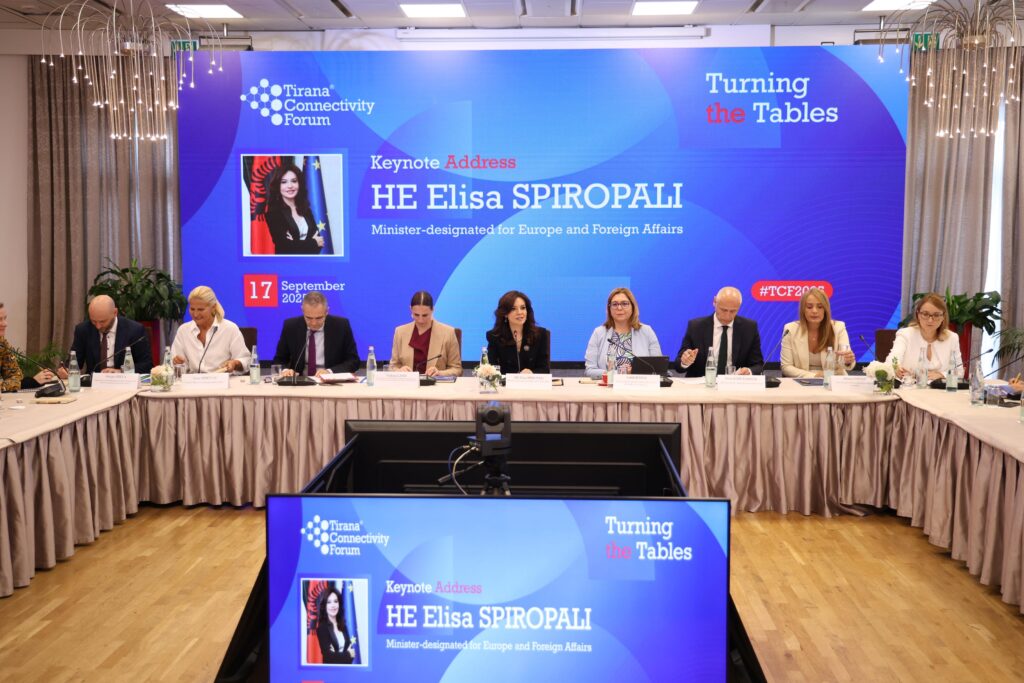
The resounding message from the opening keynote addresses of the second day of TCF2025 was one of a clear momentum and shared determination for Albania’s accession in 2030. In that endeavor, connectivity is no longer seen merely through infrastructure but as a multifaceted strategy build upon mutual trust, and encompassing economic convergence, improved competitiveness and joint security.
In her first address as Minister Designate for Europe and Foreign Affairs, Elisa Spiropali positioned connectivity as a central pillar of Albania’s foreign policy both with its neighbors and for the EU accession strategy. She highlighted Albania’s rapid progress, including the opening of 28 negotiation chapters in less than a year and the recent opening of Cluster 4 (Green Agenda and Sustainable Connectivity). Minister Spiropali detailed Albania’s concrete achievements in transport, energy, and digital connectivity. She powerfully argued that “the road towards interconnectivity passes first through intra-connectivity in our region,” emphasizing the critical need to ease travel and trade among Western Balkan capitals themselves.
H.E. Michael Reiffenstuel reinforced Germany’s unwavering commitment to the place of Western Balkans Six in EU. He stated that bringing the region closer to the EU is the “core of the strategic foreign policy,” essential for building resilience and enhancing regional security. Ambassador Reiffenstuel highlighted the enduring importance of the Berlin Process, praising its role in fostering practical integration, intra-regional cooperation, and reconciliation. He assured that Germany is ready to provide “every political, practical, but also technical support” to the frontrunner countries, Albania and Montenegro, and to the entire region in their endeavor towards EU membership.
Speaking from Brussels, Ms. Valentina Superti outlined the European Commission’s dual-track strategy: advancing the technical “engine” of membership negotiations while simultaneously delivering the tangible benefits of “gradual integration” to citizens. She praised Albania’s progress as the fastest-moving candidate country, framing the arduous chapter-by-chapter process as part of the historic mission of “unifying Europe.” To make this concrete, she announced a forthcoming initiative to eliminate roaming charges of the region with the EU and highlighted integration into SEPA, proving that the path to membership can yield real, everyday gains now.
Closing the keynote session, Mr. Amer Kapetanović injected a note of “strong and realistic regional optimism,” citing the RCC’s latest Balkan Barometer survey, which shows rising trust in regional cooperation and the highest support for EU membership in the last five years, particularly among youth. He identified the EU Growth Plan and the opportunity for gradual access to the single market as a potential “game changer.” Mr. Kapetanović concluded by reminding the audience that regional cooperation will remain essential even after EU accession, with the shared task of ensuring “that the ghosts from the past that have been haunting us for decades are finally laid to rest.”


